
Journey into the Void
Blossoms, Borders, and Buffer Zones

There are parts of this country that seem forgotten — until you drive through them.
Come with me on a voyage to the largely uninhabited Bika’a Valley. If you have a four-wheel drive, even better.If this essay spoke to you, please consider giving it a like, sharing it with someone who might need it, or reposting it. You can also support my work directly through Ko-fi—or simply by subscribing, reposting, commenting, or spreading the word. Every gesture, big or small, helps me keep writing, reflecting, and connecting through words.
A Voyage to the Bare Bones of the Bika’a
“Don’t Say This Country Is Overcrowded”
I love this country, but sometimes the endless traffic jams and lines everywhere get to me.
“This country is so overcrowded!” I often wail to my long-suffering husband, Avi. And then he sighs, shakes his head, and smiles gently in a way that maddens me all the more. “It’s simply not true,” he responds. “There are parts of Israel you aren’t thinking of. The Bika’a Valley, for one, is almost completely empty.”
“I mean, there’s a reason for that,” I retort. “Who wants to live on the border with Jordan and in the middle of the West Bank?”
Avi politely disagrees. A few years back, on a journey north, he wanted us to check out a yishuv in the Bika’a Valley. It was one of the last affordable places in the country where you could buy both a house and a large plot of land. Needless to say, one visit and that idea was scrapped. Too wild, too remote, and too run down.
And yet, the Bika’a Valley is his favorite route when heading up north for a weekend break. Route 90 has none of the nasty traffic of Highway 6. And there’s no toll fee either.
But would one call it a comfortable drive? Probably not. I, for one, am not madly keen on passing through Palestinian villages. While en route, scenarios of breaking down in an unfriendly location flash through my overactive imagination. And yet, the seemingly barren area, with all of its geopolitical complications, is of rugged beauty beyond description. Just take a detour off the beaten track and you’ll be amazed.
A couple of weeks ago, Avi forwarded me a WhatsApp message. As usual, he wasn’t pressuring me. Just passing on the info: one of the Israeli jeeping groups was offering an off-road trip through the rough and rugged terrain of the Bika’a.
I shelved my misgivings and said yes.
The Descent to Another Landscape
Last Saturday we packed food, coffee, and phone chargers and took our jeep to the northernmost tip of Jerusalem, where city becomes desert. From there we headed down, and down some more (ears popping), along a familiar route on Highway 1, passing Bedouin settlements and the sandy, carved mountains of the Judean Desert. Ten minutes beyond Jerusalem’s borders, and the cityscape of stone and cement had become a distant memory. Look out for the camels. Twenty minutes beyond that, and the ever-shrinking Dead Sea came into fleeting view as we made a left past the Allenby border crossing to Jordan.
Pit Stop at the Jordan River Baptismal Site
At this point, I most inconveniently needed the facilities, and it wasn’t going to wait. Gas stations were few and far between, but a glance at Google Maps revealed that we were indeed very close to Qasr al-Yahud, the Jordan River baptismal site — toilets aplenty.
I have taken my Diplomacy Studies students to Qasr al-Yahud on numerous occasions. The site itself, a mere hour’s drive from our school, demonstrates history, culture, crossroads, and conflict in one place. The only thing that stands between us and Jordanian territory is the narrow, shallow, badly polluted yet religiously significant Jordan River.
Its murky and hazardous waters don’t deter hundreds of thousands of Christian pilgrims, who arrive by the busload from all over the world, from immersing themselves in the stream. It is, after all, the very site where John the Baptist baptized Jesus.
Jews don’t visit the site much, but they should. It is the story of our beginnings. This is the very river we crossed when we entered the Promised Land.
It is a river of miracles for Jews and Christians alike.
I felt just a drop unholy as I crossed through the gift shop with its crosses and trinkets, passing white-clad pilgrims exiting the changing rooms for what would be the most important spiritual moment of their lives. But needs must.
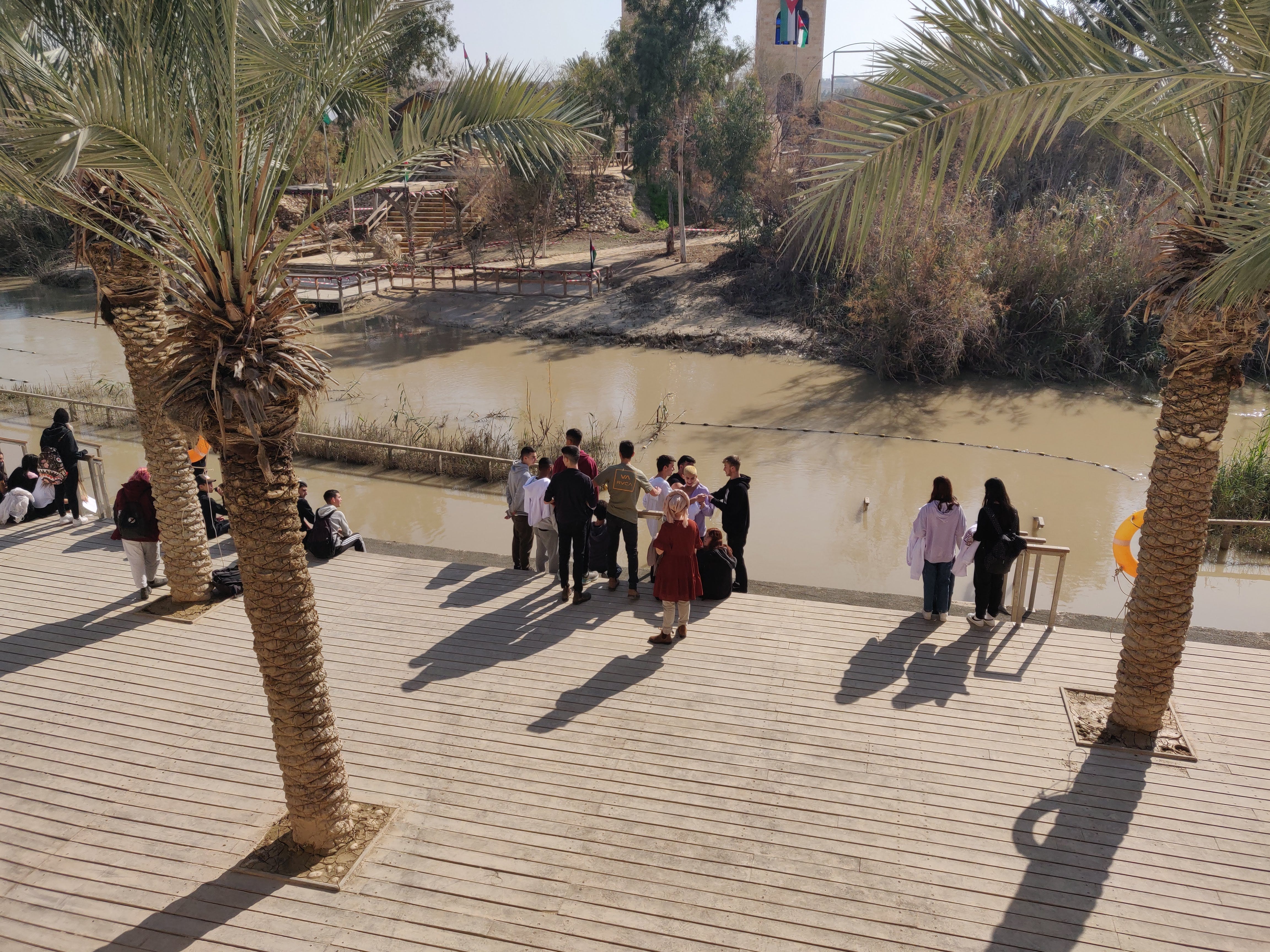
a class visit to the Jordan river in 2019
Landmarks: The Personal and the Political
After our small detour, we had very little time to get to our meeting point. We passed Bet Hogla, a young settlement of caravans where Avi’s son and family live, but we didn’t stop by. It was Shabbat morning, and most likely Avi’s son, Hoshaya, would be in synagogue.
We then passed the Church of St. Gerasimus, a glorious Greek Orthodox church surrounded by greenery, which has an on-site mosaics factory that makes fabulous artwork using local stone.
We passed a sign for the entrance to Jericho, a city I have visited twice, even though technically Jews cannot enter the city. The first time I was about ten and still living in the UK.
I remember my dad, who took us there as kids. We were on a family vacation, and it was over a decade prior to the Oslo Accords. “Kids,” declared my father, “this is the oldest city in the world.” At the time, all I saw was stones. But I believed him.
I recently visited with an organized group — we had gotten permission and an armed guard. With its natural springs and towering date palms, it enjoys balmy temperatures in the winter without the dryness of the Dead Sea area. Nobody could call the area boring — with its archaeological mound of ancient Jericho, Hisham’s Palace, the Mount of the Temptation, and a sixth-century Byzantine synagogue, it really has so much to offer. Right now, sadly, it’s only for non-Jews and Muslims. I hope things will change.
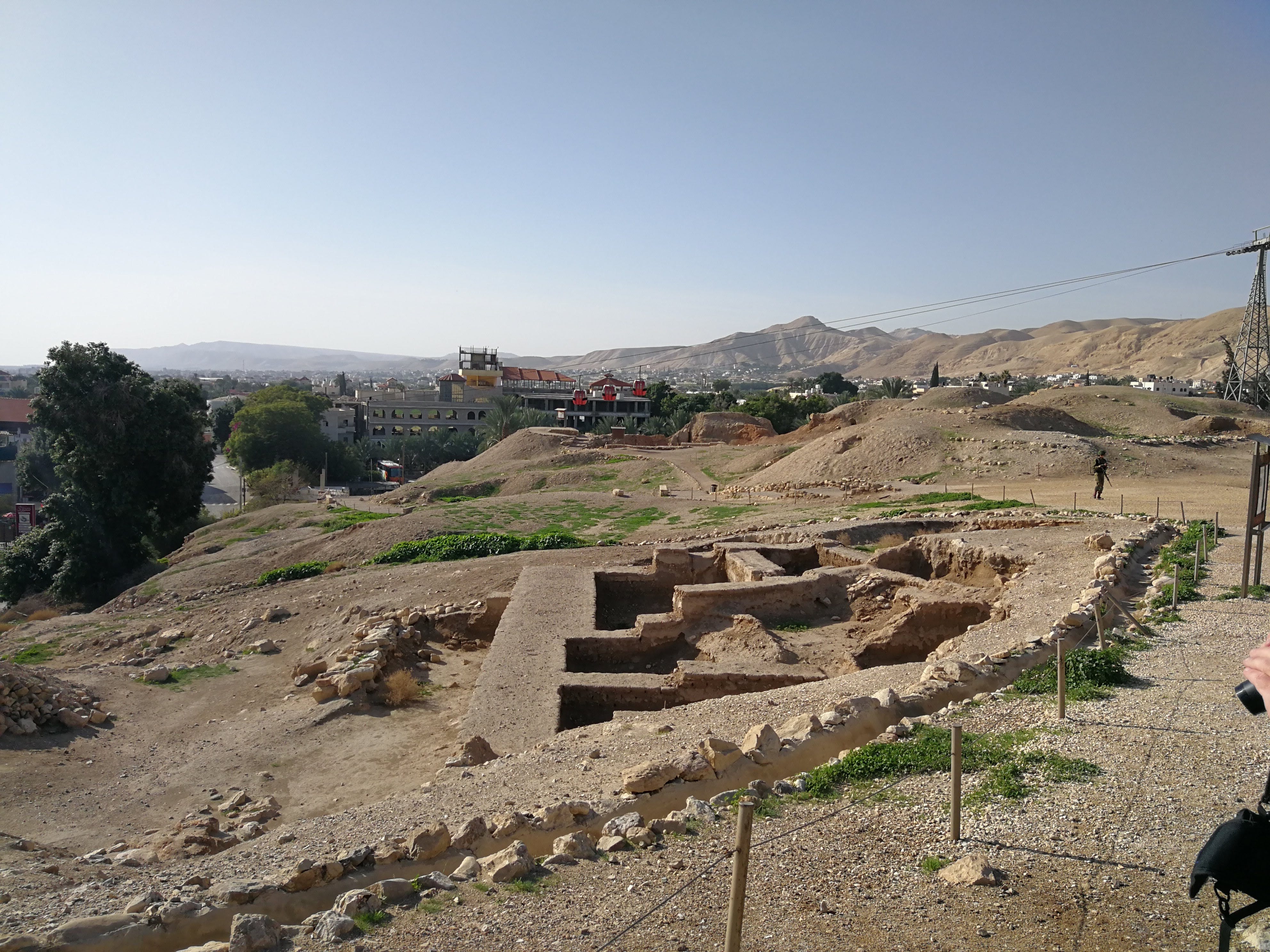
ancient Jericho
Route 90: Faded but Very Much Alive
We were sailing down Highway 90, the longest road in Israel, stretching 480 kilometers from Eilat in the south to Metula on the Lebanese border in the north.
The route is curved, scenic, and above all, empty. Gazing at the hilltops, now lightly dusted with a crew cut of green grass extending far into the distance toward the Jordan Valley, I suddenly felt like I could breathe. Expanse always does that to me.
Israel was blessed with much-needed heavy winter rains over the past couple of months. Every now and then we would get a worrying news report about water levels in the Kinneret. But we are good, for now.
I don’t remember ever seeing the eastern part of the Judean Desert so green.
We passed tired-looking villages, some belonging to Areas A, some B, and some C. We passed faded signs for car repair places and shuttered restaurants. The only things that were alive and vibrant were the huge date plantations. The Bika’a Valley’s extreme heat, long summers, and mineral-rich soil make it one of the best regions in Israel for growing dates, particularly the prized Medjool variety. We always have a package of impossibly sweet Medjool dates in our fridge, and they make a perfect snack.
We passed other fields too; the year-round warm climate provides a perfect greenhouse for peppers, tomatoes, and other herbs, many grown by Arab farmers, but some by Jews who populate moshavim and kibbutzim in the valley.
The Jeeps Meet
It was 9 a.m. when we arrived at the gas station. It was a sorry place. Various stores appeared to have opened and then gone out of business, and other than our company of jeeps, there was a lazy group of feral cats basking in the sun.
Living in the Bika’a can’t be easy. The summers are ferocious, with temperatures soaring. Employment options are limited, and the neighbors aren’t as friendly as one would like. But many Israelis live there — between 10,000 and 12,000 residents in scattered moshavim and kibbutzim.
Families, couples, and lone drivers climbed out of their vehicles to introduce themselves. Two of the jeeps in the convoy belonged to Druze families from the north. They conversed with each other in Arabic, but their Hebrew was easy and fluent. Our guide was equipped with a gun (just in case), as were several other drivers, including one of the Druze. In Israel, guns are worn close to the body, almost as an accessory — more reassurance than threat. We were, after all, less than a kilometer from the Jordanian border, in a region where geography has never been neutral.
Our guide showed us the route on his map. He described the technical challenge of the road as “not hard,” meaning no jeep was at risk of falling off a sheer rock face and there would be no sections that involved jeeps making four attempts before passing narrow and rocky terrain. This, we hoped. We’ve done the Negev and the Dead Sea section of the Judean Desert. This gravelly path through flowers and fields looked more welcoming than other routes we’ve taken. But hey, we were here for the challenge too.
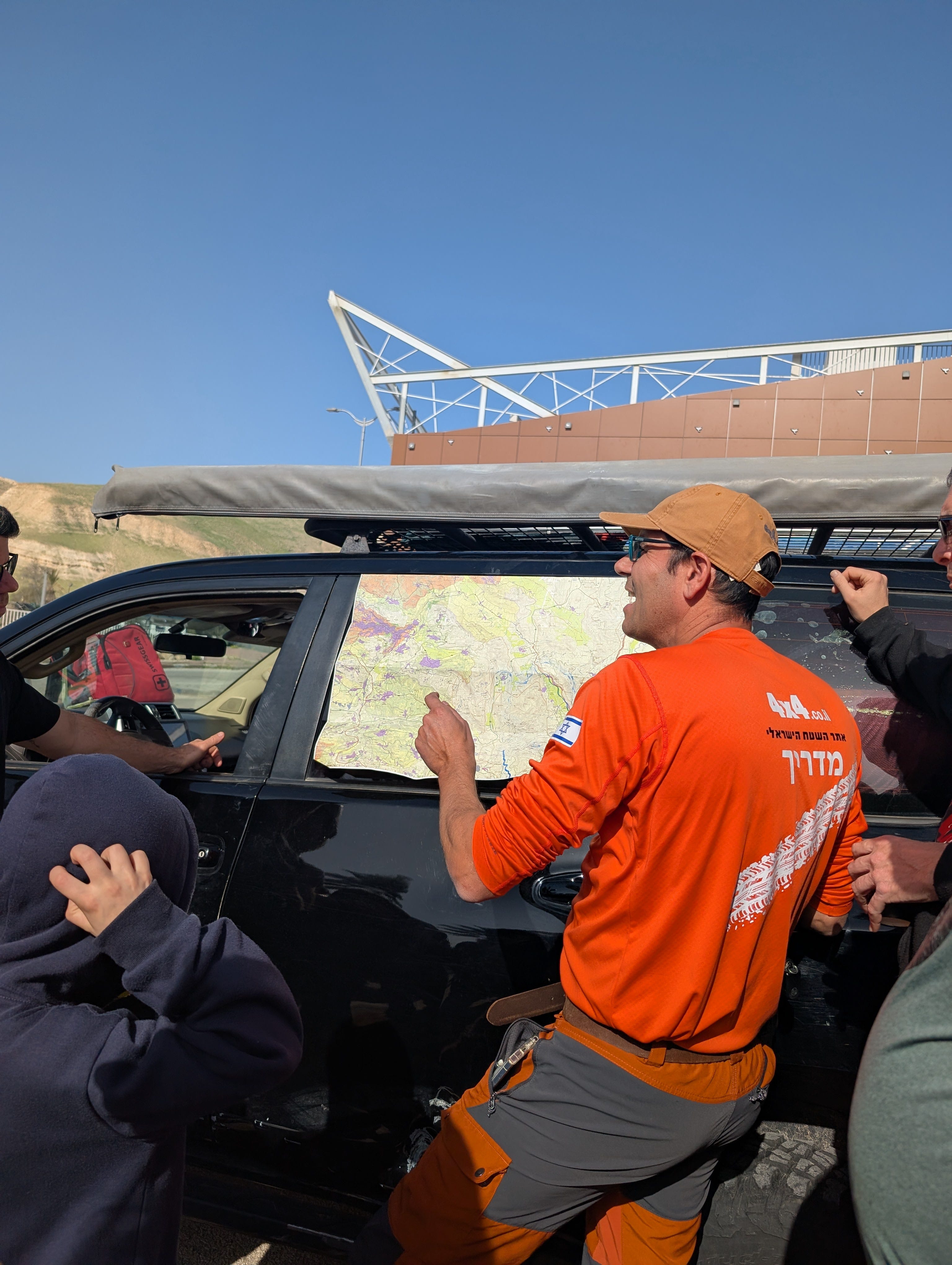
the route explained
Springtime in the Desert
I was totally unprepared for the otherworldly rugged beauty of this semi-arid terrain. I also hadn’t expected the flowers. It was mid-February, when people in many countries are still scraping snow off their windshields. But here we were, having made a whirlwind transition from the dusty dry heat of September to the howling wind and rain of December and January.
Then, as if on cue, the almond blossoms flared white, and the slopes erupted in color: red anemones, purple irises, lupines spilling across the desert floor. Each ridge seemed to choose its own signature bloom.
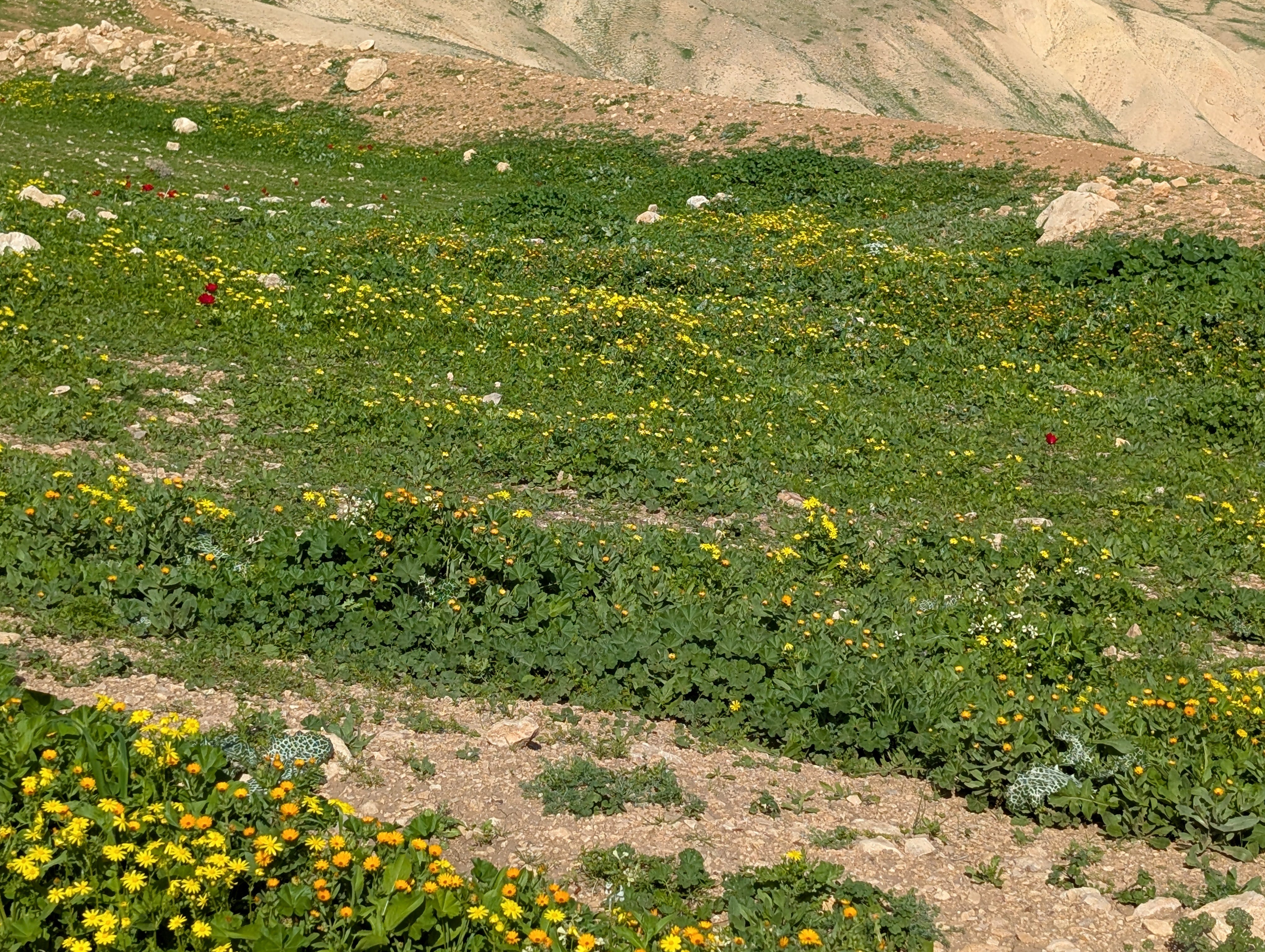
yes, flowers in the desert
It is mid-February — the cold weather is far from over (in Jerusalem, anyway) — but for now, the winter rains have disappeared to grab a coffee before the next deluge. It’s time to put on your shades and go admire the flowers. Spring in Israel is a limited-time offer. It’s forbidden to pick wildflowers, but photos are welcome. My Facebook feed is already overcrowded with almond blossom pictures, as if it’s the first time anyone has ever seen them.
And yes, according to biblical prophecy, the desert is blooming too.
Our guide told us that this section of the desert gets just enough rainfall to allow this — 15–30 cm. It’s not much, but the muddy puddles that Avi insisted on driving through bear witness to this year’s excess rain.
A Landscape That Is Pre-Genesis
Whenever we stopped for coffee, pee breaks, lunch, or just a quick explainer, we noticed that not all the hilltops surrounding us were green. We were viewing a patchwork of green and sandy stone. North-facing hilltops retain their moisture, whereas southern ones are exposed to the harsh rays of the sun. Yes, the Bika’a Valley has its own microclimate, just like the rest of our country.
With nothing in our sightline beyond hillsides and bright blue sky, it was as if we had been tossed into a landscape and era prior to Creation itself — as though, rather than being in 2026, we were viewing the beginning of time, jeeps and all.
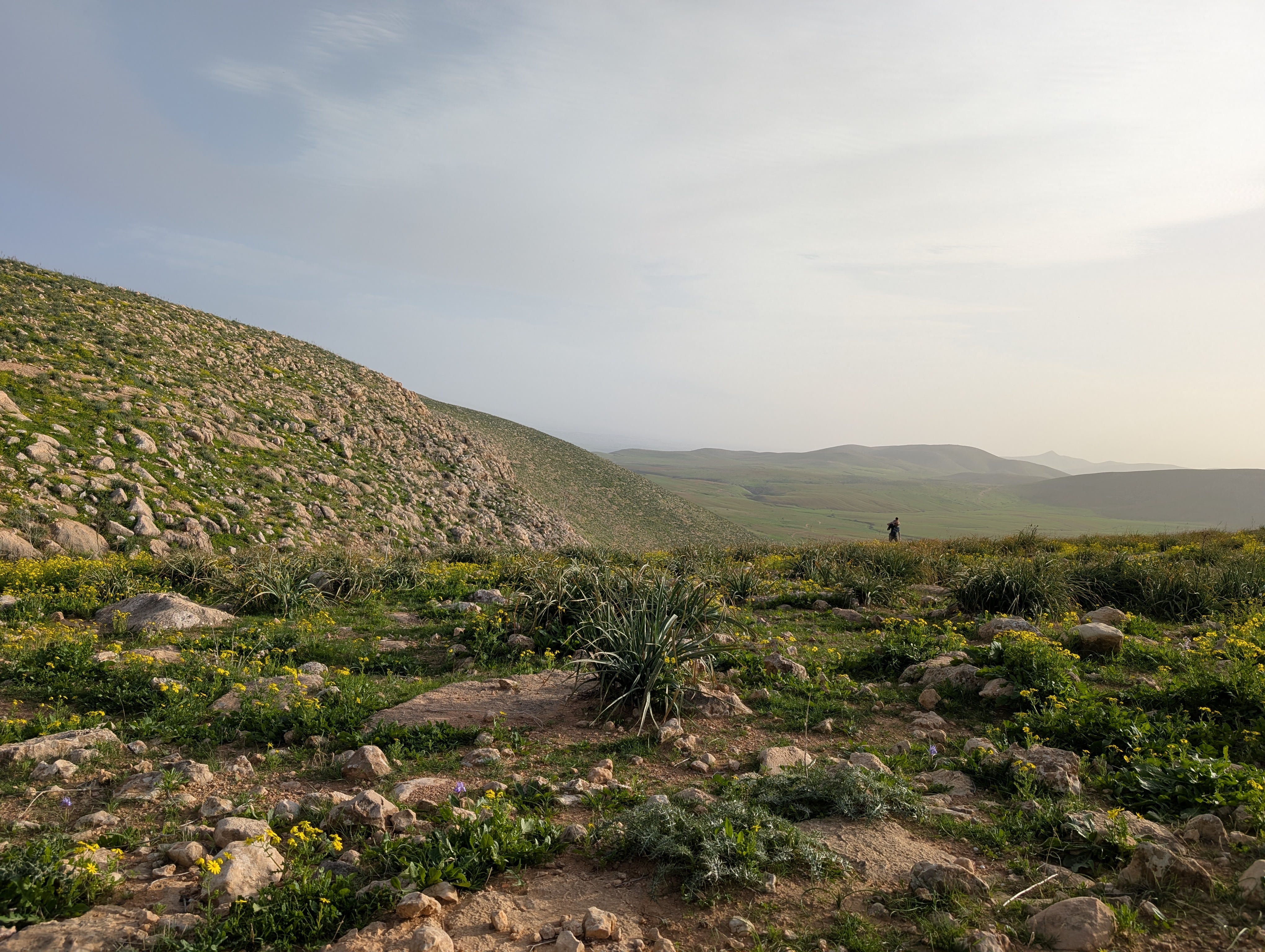
Everything is extreme here, even the contrast between some of the high-tech jeeps (when it comes to hobbies, Israelis always go all out) — with running water, mini refrigerators, satellite GPS systems, and tires that roll over rock as easily as a knife through butter — and the outside world of rocks and gravel, blossoms and gentle grasses.
This empty, apocalyptic landscape is deceptive. It hides its crowded truths: layers of history, biodiversity, and, of course, complicated geopolitics.
The faded signs that become Route 90’s helpful landmarks belie something much more ancient than chipped paint. This is the corridor — not just for the Jews who crossed into the Promised Land from the east, but also for the great civilizations that used this route for trade and migration. Empires moved through here: Egyptians, Assyrians, Babylonians, Greeks, and Romans. But we were the ones who stayed.
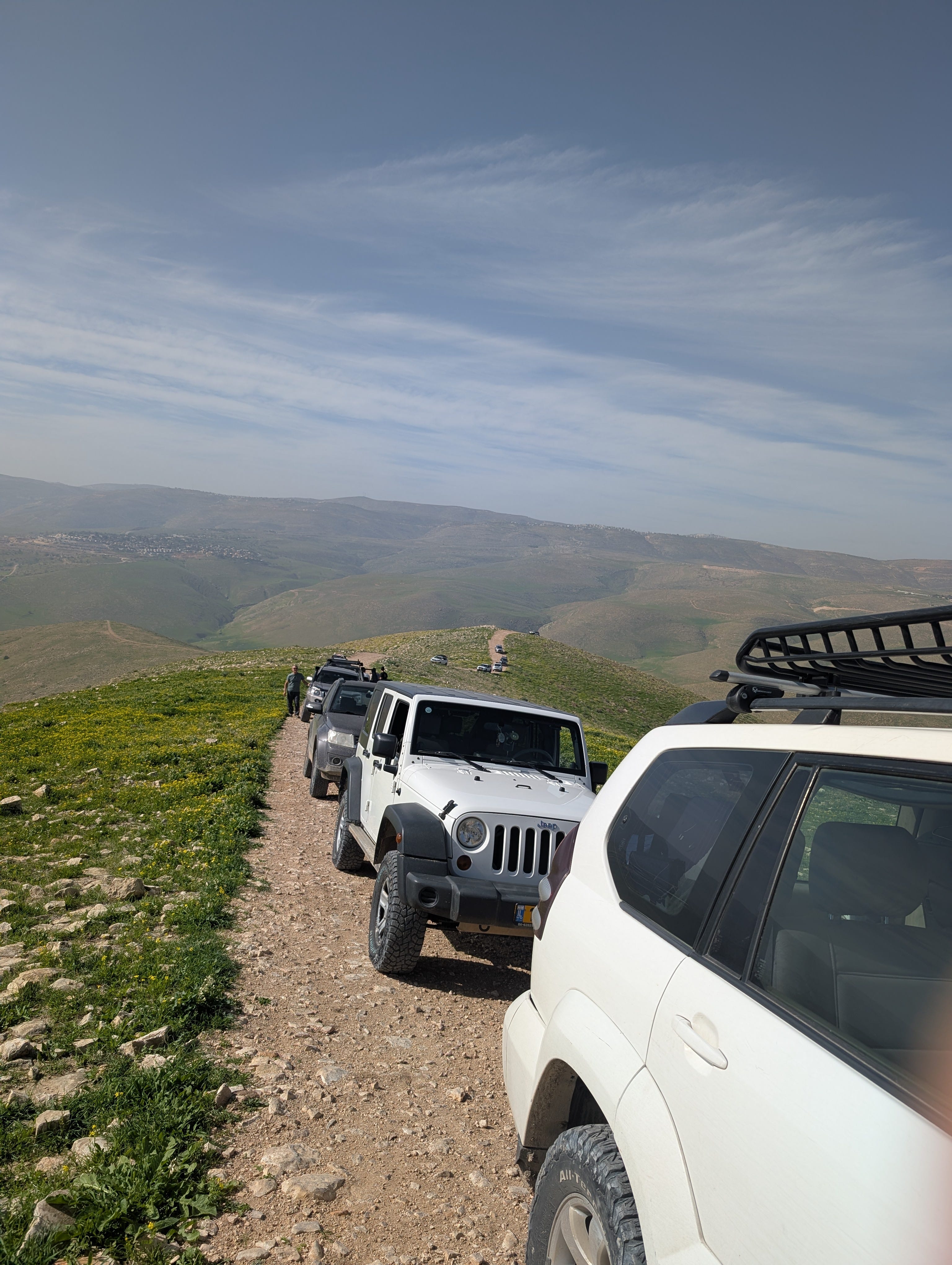
the corridor
The only signs of military conquest we see today are abandoned firing ranges and a tank training ground. In the 1960s, Yigal Allon had a vision that the Bika’a would serve a strategic purpose — a buffer zone. His solution was to settle this harsh, rugged land and harness the intense sun and greenhouse conditions through the growth of agricultural settlements, which would serve as a security buffer.
The packages of Medjool dates you buy in your supermarket may tell you whether they are Israeli or Palestinian produce, but the orchards below bore no such labels.
The Bika’a is the longest border stretch — 300 kilometers in total — running along the Jordan River.
I might feel a sense of serenity in the hills, but security isn’t something to be neglected. My stepson was one of the thousands of extra troops sent to bolster this border in 2023. Incidents happen all the time, war or no war.
One of our first stops was at a monument for soldiers who fell defending the Bika’a Valley. The names are embossed on silver placards on a towering wall. The view is of emptiness, but the monument is a testimony to the deep strategic weight of this area and the heavy price paid to defend it.
After proceeding on the hilly track for a couple of hours, our guide stopped at a deep grassy field and declared it was time for “brunch.” The Druze family immediately opened several folding tables and chairs, donned silicone gloves, and got to work right away, skillfully coordinating a full, restaurant-standard meal that included grilled meat, freshly cut salad, and tabbouleh. We clutched our sandwiches and gazed at the hive of activity enviously.
Our guide went round with a pan of fried liver, offering the travelers a taste.
Avi pointed out that we were sitting inches away from a sprawling mound of pine processionary caterpillars. In a week or two they will descend underground to form pupae and then become moths. I really wanted to imagine them as butterflies. But the idea of them emerging from the darkness with wings was symbolic enough for me.
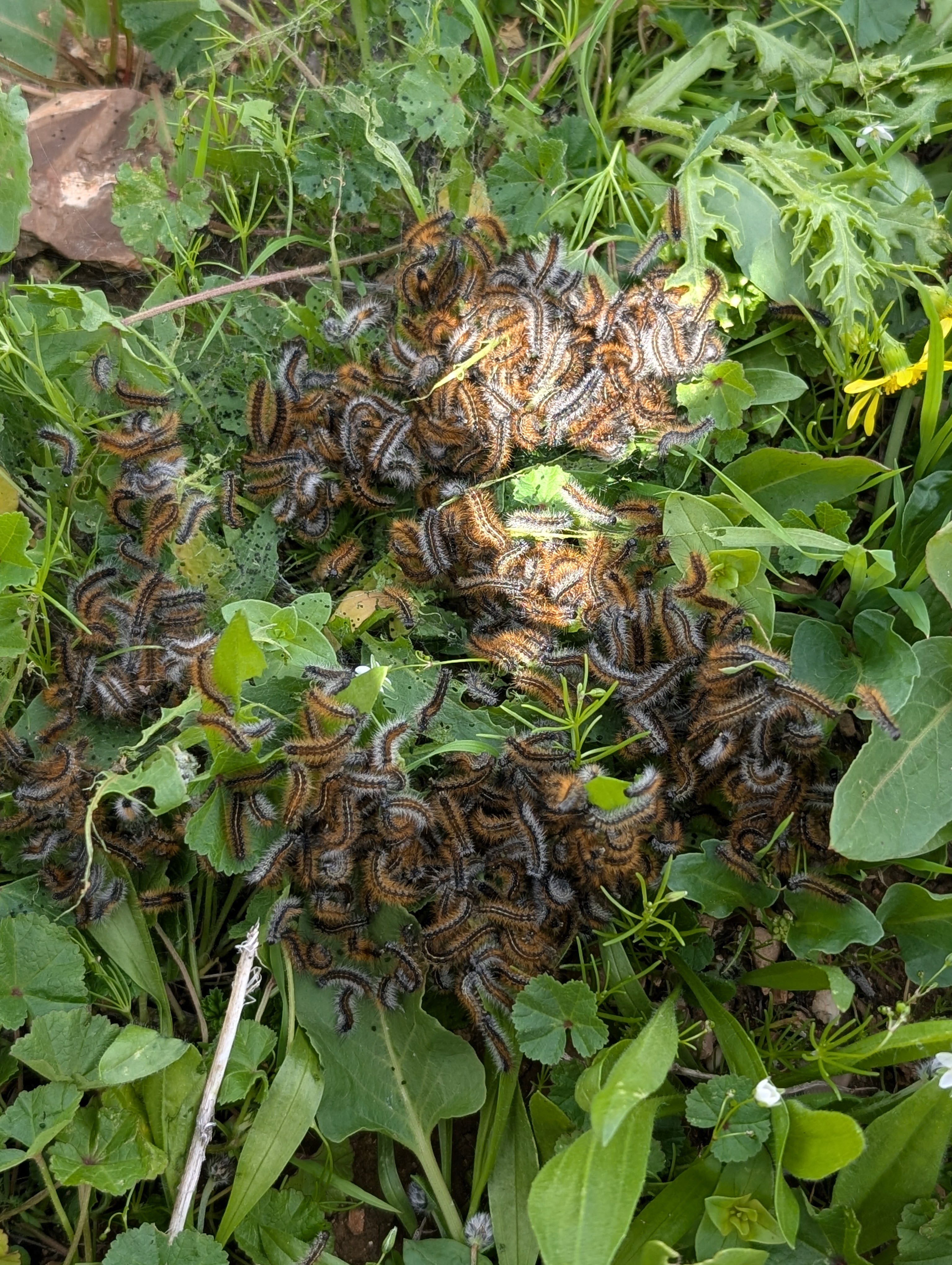
processionary caterpillars
Driving in a jeep, it is easy to forget about borders and Areas A, B, and C. All we could see were hills and valleys. We had to climb and descend, power gear in place and foot firmly on the brakes. I had a go at jeeping too — even if it was just to prove it’s not just a man’s thing.
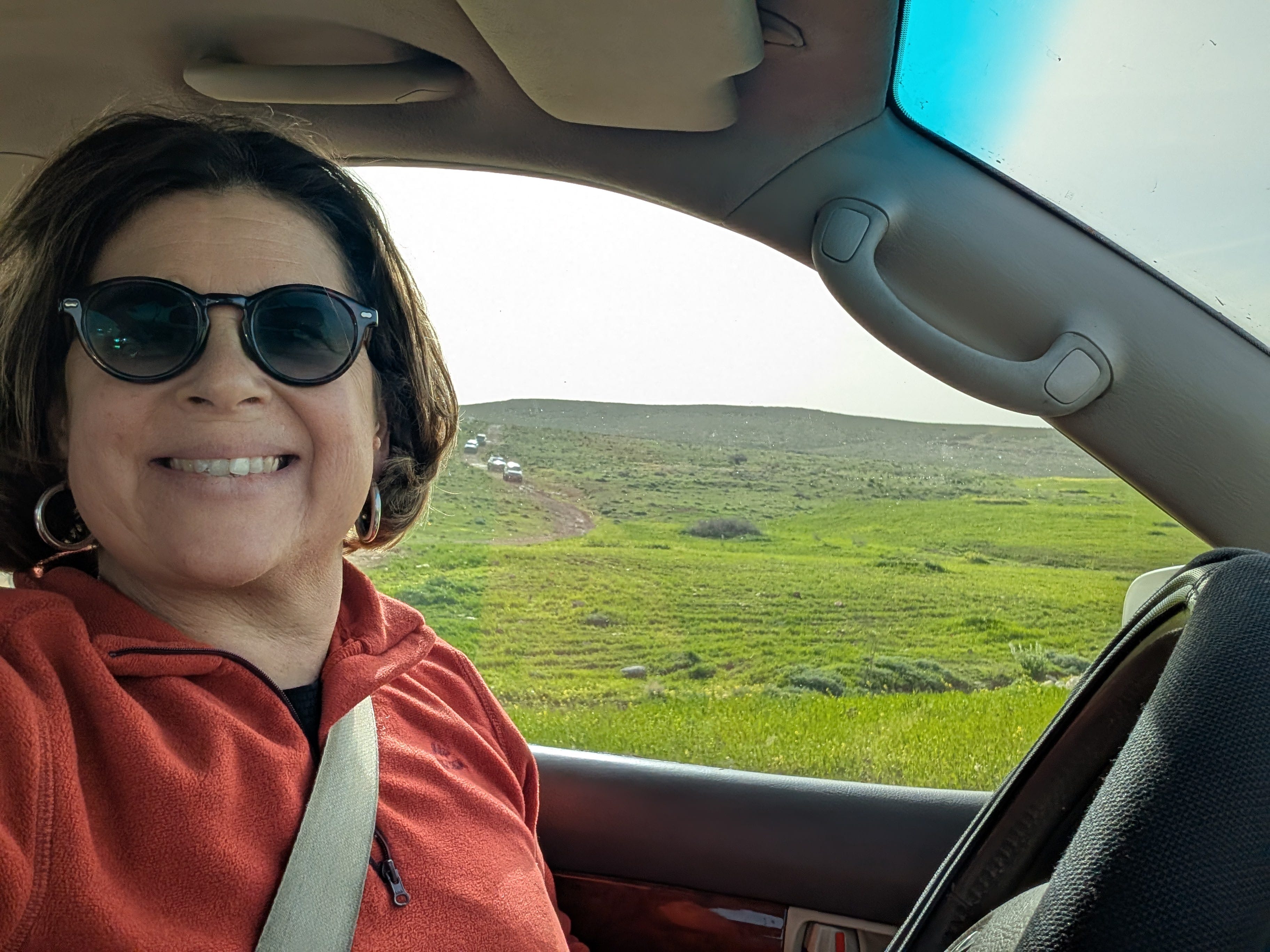
behind the wheel
We passed small Palestinian farming settlements in the valley. The children ran out to wave at us. Life isn’t easy here — the heat is punishing, work is uncertain, the land demanding.
Our guide gestured east, across the river into Jordan, where water is strictly rationed and farmers receive far less state support. The climate is shared; the infrastructure is not.
We were somewhat delayed as a giant herd of goats appeared on the track, as if from nowhere. In the desert, things don’t slowly come into view; they simply emerge. I cannot imagine what it was like for my forefathers in these lands, with their manna and hope as their only source of nutrition during those long years of sand, wind, and scorching heat. Oh — and faith, of course.
The route took us the entire day, even though it was only 25 kilometers or so. The pace was good — not too much stopping and starting, which we’ve experienced in the past. The weather was warm and windy. I donned a red and grey keffiyeh that I bought from a Bedouin in the northern part of the Judean Desert a few years ago, just to stop the wind from pulling my hair into my eyes. It certainly did the job, and I looked quite the part.
The road was equally empty coming home. On a mild, sunny February Saturday, I expected that the regular tourist hotspots in Israel would be mobbed. I smiled at the thought. Save the goat farmers, we hadn’t encountered anyone on our trail. In this country, that’s called a miracle.
The skies, however, told a different story. We saw several flocks of birds on migration routes. I’m not a birdwatching expert, but they weren’t common pigeons or crows. I’m pretty sure I saw a flock of storks soaring overhead. It’s migration time, and millions of birds are making their way from Africa to Europe. We might complain about the heat, but the thermal currents provided by the valley give the birds a very convenient shortcut. Flapping their wings over oceans is a lot more tiring. I pointed them out, but Avi missed them — he was at the wheel.
The guide had told us that the spring blossoms are at their most intense in another month. We made a mental note to return.
Maybe this time I’ll spend more than two minutes at Qasr al-Yahud. I’ll wave at the people on the other side, perhaps. Or maybe I’ll go into the mosaics workshop — I hear they offer classes. Then I can buy a box of Medjool dates and savor them at the wheel. Who knows, maybe somebody will open up a food truck around here. They seem to be sprouting like mushrooms everywhere else in this country. A Jew has to eat, after all.
We made a pit stop at Avi’s stepson on our way back. Shabbat was just ending, and they were sitting outside enjoying the peaceful sunset. We chatted about this and that. Hoshaya is ginger, pale-skinned, with long curly peyot. His wife is Ethiopian, with almond-shaped eyes and a graceful smile. Their girls have corkscrew curls and complexions that look neither Ethiopian nor Ashkenazi. Their baby son is pale-skinned with dark brown hair.
They’ve been offered a job on the yishuv looking after a herd of local goats and are seriously considering it. The income from the milk could be quite handy.
Avigail, the oldest, is almost three. She has not yet learned the Bible stories, nor the chapters that came after them. For now, she sees only date palms and open sky.
One day she will inherit the layers beneath her feet.
This is, after all, a land that remembers — and a land that promises.
It turns out there is room here after all — for blossoms, for borders, for birds, and for her.
If you enjoyed this deep dive into the Jordan Valley, consider sharing it with a friend who loves travel and history.
What's a place that reminds you of your country's history? Let me know in the comments.